


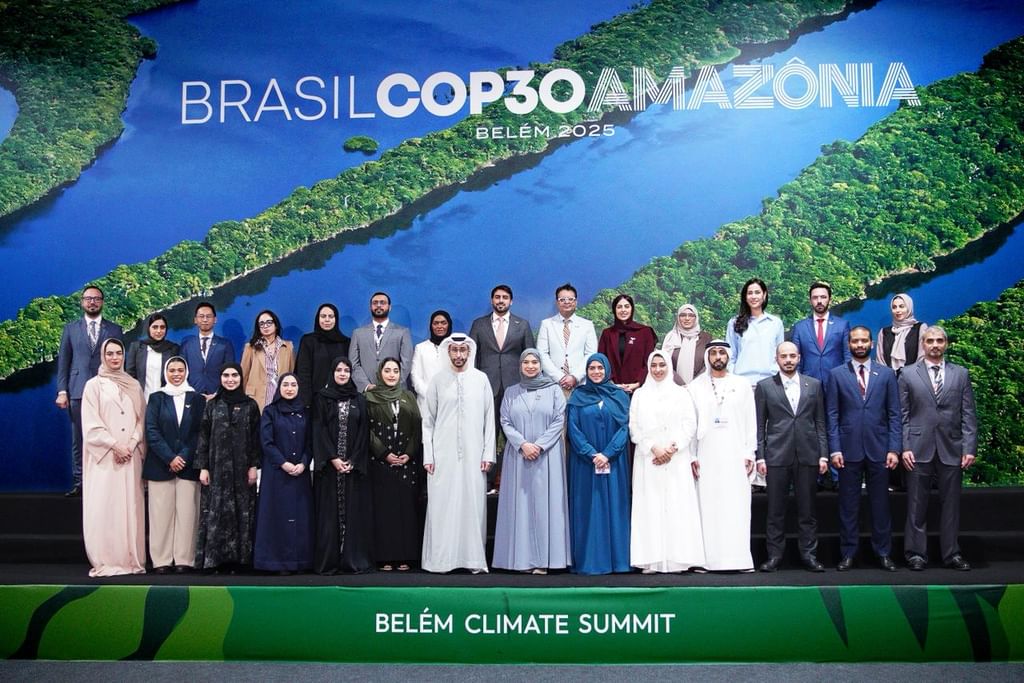
The United Arab Emirates (UAE) continues to demonstrate its unwavering commitment to global climate action, most recently highlighted by its active participation in the COP30 conference held in Belém, Brazil. Led by Her Excellency Dr. Amna bint Abdullah Al Dahak, Minister of Climate Change and Environment, the UAE delegation emphasized the nation’s dedication to accelerating climate efforts, mobilizing innovative financing mechanisms, and fostering comprehensive global partnerships. This article delves into the key takeaways from the UAE’s involvement in COP30, showcasing its leadership role and ambitious goals in the fight against تغير المناخي (climate change).
UAE Leadership at COP30: A Commitment to Accelerated Action
Dr. Amna Al Dahak spearheaded the UAE’s presence at COP30, delivering a powerful statement that underscored the country’s pivotal role within the “Troika of COP Presidencies.” This refers to the consecutive presidencies held by the UAE (COP28), Azerbaijan (COP29), and Brazil (COP30), allowing for continuity and increased momentum in global climate negotiations. The UAE pledged its full support to the Brazilian presidency, recognizing the importance of a unified front in tackling this global challenge.
Dr. Al Dahak stressed that the ambitious path set forth during COP28 with the historic “Emirates Agreement” and further developed through efforts in Baku, must now gain real traction in Belém. She envisioned COP30 as a crucial launching point for establishing robust and sustainable principles in global climate work.
Towards Net Zero by 2050: UAE’s National Strategy
The UAE’s commitment to achieving الحياد المناخي (net zero) by 2050 remains steadfast. Dr. Al Dahak highlighted the nation’s ongoing efforts to triple renewable energy production capacity and implement transparent emissions monitoring systems. These initiatives are designed to contribute significantly to the achievement of global climate objectives.
“We believe that preserving nature and biodiversity is an inseparable part of climate action,” Dr. Al Dahak stated. The UAE’s National Biodiversity Strategy 2031 sets ambitious targets, ranging from protecting terrestrial and marine areas to improving the status of endangered species.
Mangrove Conservation and Global Partnerships
The UAE is making significant strides in nature-based solutions, particularly through mangrove restoration. Having already achieved half of its goal to plant 100 million mangrove trees, the country is leading international partnerships like the “Mangrove Alliance for Climate” in collaboration with the Republic of Indonesia. This demonstrates the UAE’s belief that protecting nature is a fundamental pillar of its climate policies, a principle recently reinforced by hosting the World Conservation Congress.
Prioritizing Ambition, Adaptation, and Finance
Dr. Al Dahak called for a unified global approach centered around three key priorities: raising ambition through Nationally Determined Contributions (NDCs), achieving tangible climate adaptation, and expanding financing with innovative mechanisms. She specifically referenced the UAE’s $30 billion “ALTERRA” fund, launched during COP28, as a prime example of such innovative financing. This fund aims to mobilize private capital towards climate and environmental projects.
Recognizing the critical importance of water security, the UAE also emphasized its focus on addressing global water scarcity through pioneering initiatives like the “Mohammed bin Zayed Water Initiative.” This initiative seeks to develop solutions to tackle water challenges worldwide. Further solidifying this commitment, the UAE will host the “United Nations Water Conference 2026” in partnership with the Republic of Senegal.
Cooling Global Efforts: A New Momentum
The UAE actively participated in the Ministerial Roundtable on the “Global Cooling Pledge,” highlighting the rapid transition of the pledge from commitment to practical implementation, supported by 72 countries. Dr. Al Dahak lauded the conference’s key outcomes, including the official adoption of the International Governmental Committee on Cooling (IGCC) and the activation of the EPIC facility as a central financial and technical mechanism.
The UAE has integrated sustainable cooling into its NDCs, recognizing its potential to reduce global emissions by approximately 78 billion tons by 2050 through collective action. This demonstrates a forward-thinking approach to tackling الاستدامة (sustainability) challenges.
UAE’s Integrated Approach: Urbanization and National Action
Mohamed Saeed Al Nuaimi, Undersecretary of the Ministry of Climate Change and Environment, also played a prominent role at COP30, participating in key events and showcasing the UAE’s integrated approach to climate action.
During the Ministerial Meeting on “Urbanization and Climate Change,” Al Nuaimi presented the UAE’s experience, emphasizing a unique model that balances national objectives with innovation and relies heavily on collaboration through the “UAE Climate Action Council,” which brings together representatives from the government and private sectors. This ensures that national strategies, such as the UAE’s Net Zero Strategy 2050 and the UAE Energy Strategy, are translated into concrete local action plans.
Nature and Climate: A Symbiotic Relationship
Al Nuaimi further underscored the importance of translating climate ambition into coordinated action and shared responsibility across all levels of society. He highlighted the UAE’s commitment to protecting forests, recognizing them as the “lungs of the Earth” and a vital first line of defense against climate change due to their crucial role in absorbing emissions and maintaining ecological balance.
Dr. Anoud Abdullah Al Haj, Assistant Undersecretary for Green Development and Climate Change, contributed to specialized ministerial dialogues focusing on adaptation pathways, just transition, and the green economy. She emphasized the importance of a “global toolkit for a just transition” and a collaborative approach to linking countries’ needs with financing mechanisms. She also showcased the UAE’s progress in implementing its National Green Agenda and achieving net zero, including the launch of the national MRV (Measurement, Reporting, and Verification) system.
In conclusion, the UAE’s active and impactful participation in COP30 reaffirms its position as a global leader in العمل المناخي (climate action). Through its ambitious national strategies, innovative financing initiatives, and commitment to international collaboration, the UAE is not only working towards its own net-zero goals but also driving momentum for a more sustainable future for all. The nation’s integrated approach, encompassing adaptation, mitigation, and nature-based solutions, provides a valuable model for other countries seeking to accelerate their climate efforts.