


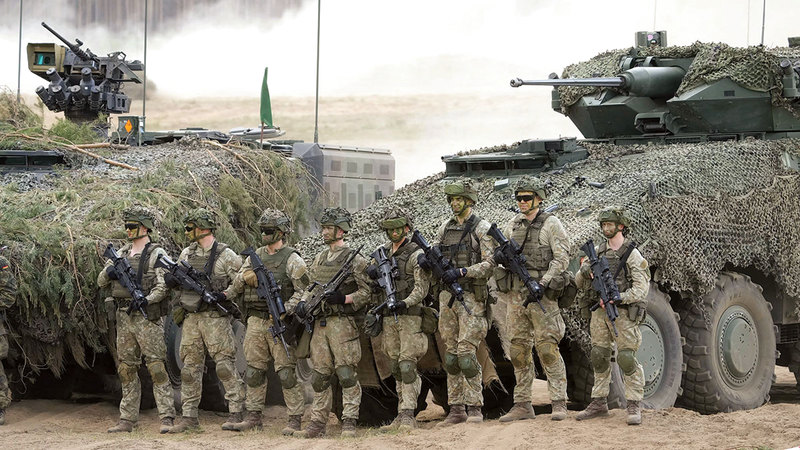
For decades, a tacit understanding governed the European Union: Germany would lead on finance, while France would take the military reins. Now, that arrangement is undergoing a dramatic shift. With Germany rapidly expanding its military capabilities and aiming to become a dominant force, the political balance of power is being redrawn. France is striving to maintain its influence, and in Poland, the resurgence of German military power is stirring anxieties rooted in history, leading to considerations of a stronger Berlin-Warsaw alliance as a deterrent to Russia. This article delves into the implications of this German rearmament and its impact on the future of European security.
A Shifting Landscape: Germany’s Military Ascendancy
Germany, long hesitant to fully embrace a leading military role, is now actively pursuing a substantial build-up of its armed forces. This isn’t simply a matter of increased spending; it’s a fundamental change in mindset and ambition. As Christoph Schmid, a member of the German Parliament’s Defense Committee, stated, “Wherever you go in the world, from the Baltic states to Asia, people are asking Germany to take on more responsibility.” He further emphasized the expectation that Germany will finally align its defensive strength with its considerable economic weight.
This isn’t the Bundeswehr of the past, often criticized for its disorganization and outdated equipment. Today’s German army is the largest in Europe, equipped with advanced tanks, missiles, and aircraft. This growing military prowess, coupled with Germany’s economic strength, necessitates a recalibration within Europe. The continent is adapting to the reality of a more assertive, and potentially dominant Germany.
The Scale of the Transformation: Budgets and Timelines
The financial commitment behind this shift is staggering. By 2029, Germany is projected to spend a massive €153 billion annually on defense, representing approximately 3.5% of its GDP. This marks the most ambitious military expansion since the country’s reunification. In contrast, France plans to reach around €80 billion by 2030.
Poland, acutely aware of the geopolitical situation, is also significantly increasing its defense budget, allocating €44 billion this year – equivalent to 4.7% of its GDP, the highest percentage within NATO. Poland aims to possess one of the largest and best-equipped armies in Europe.
However, the financial landscape isn’t uniform. While Berlin benefits from relatively unrestricted borrowing capacity, Paris grapples with a debt exceeding 110% of GDP and a budget deficit surpassing 5%. Poland, too, faces challenges in controlling public spending, exacerbated by the surge in defense investments. This disparity in financial flexibility adds another layer of complexity to the evolving power dynamics.
A “Seismic Shift” in European Power
The transformation in Germany’s military power is being described as a “seismic shift” and “a huge change” by EU officials. It’s not merely a budgetary issue; it fundamentally challenges the established narrative of who safeguards European security. Discussions in Brussels center on the “European-ness” of Germany’s military build-up, questioning whether it aligns with collective European interests.
Berlin is fiercely protective of its national interests in defense, resisting greater authority for the European Commission in arms procurement. Instead, it intends to rely heavily on national frameworks, utilizing a new procurement law that leverages Article 346 of the EU Treaty, allowing it to bypass EU competition rules in favor of domestic contracts.
Internal procurement documents reveal Germany is preparing to commit €83 billion to defense contracts through parliamentary committees by the end of 2026. This unprecedented surge encompasses all branches of the armed forces, from tanks and frigates to drones, satellites, and radar systems. Furthermore, a larger “wish list” totaling €377 billion outlines a long-term plan covering over 320 new weapons programs.
Implications for European Defense Industry and Alliances
A surprising aspect of this build-up is the intended destination of these billions. Less than 10% of new contracts are expected to go to American suppliers, a significant departure from the long-standing relationship where Germany was a major US defense client. The vast majority of contracts will remain within Europe, with the lion’s share benefiting the German defense industry. This represents a substantial boost for German manufacturing and technological capabilities.
This shift has significant implications for the European defense industry, potentially creating a more self-reliant, but also more concentrated, market. France, with its own robust defense sector, views this development with a mixture of skepticism and concern. As one EU official noted, “In France, the defense apparatus is at the core of the system. The difference between Paris and Berlin is that any official in France is, ultimately, a defense official.”
Despite efforts by French President Emmanuel Macron to strengthen Franco-German relations since 2017, distrust towards Berlin remains deeply ingrained within French defense circles. However, not everyone perceives German rearmament as a threat. In Warsaw, it’s seen as a necessary and overdue step.
Eastern Europe’s Perspective and a Potential Berlin-Warsaw Axis
Poland has consistently advocated for increased military spending among NATO allies. Former Polish Ambassador to the US, Marek Magierowski, stated, “Poland has been a shining beacon among NATO allies in terms of military expenditure. Therefore, we insist that other partners follow suit.” He added that questioning Germany’s increased defense spending while urging others to invest more is inconsistent.
Polish officials, speaking off the record, expressed a pragmatic view, acknowledging that Germany is “moving in the right direction.” However, the historical context cannot be ignored. Deputy Minister of Defense Paweł Zalewski cautioned, “If we look at history, any situation where Germany links its economic power to its military power has always raised concerns.” He emphasized that Poland, possessing the largest land army in Europe, will be a significant player in the future, and Germany’s military modernization must be viewed within that context.
The historical anxieties, combined with the current geopolitical realities, are fueling speculation about a closer alignment between Berlin and Warsaw. A strengthened Berlin-Warsaw axis could serve as a powerful deterrent to Russian aggression, reshaping the security landscape of Eastern Europe. This potential alliance is a direct consequence of the changing dynamics spurred by Germany’s military spending.
Conclusion: A New Era for European Security
The rapid rearmament of Germany is undeniably a watershed moment for Europe. It signifies a fundamental shift in the continent’s power balance, with economic strength increasingly translating into military capability. While this development is welcomed by some as a necessary step towards greater European security and burden-sharing, it also raises legitimate concerns about national interests, industrial competition, and historical legacies.
The coming years will be crucial in determining whether the EU can effectively integrate this new reality into a cohesive and collaborative security framework, or whether it will lead to further fragmentation and rivalry. The future of European defense hinges on navigating this complex transition with foresight, diplomacy, and a commitment to collective security. Further analysis and open dialogue are essential to understand the long-term implications of this evolving landscape.