


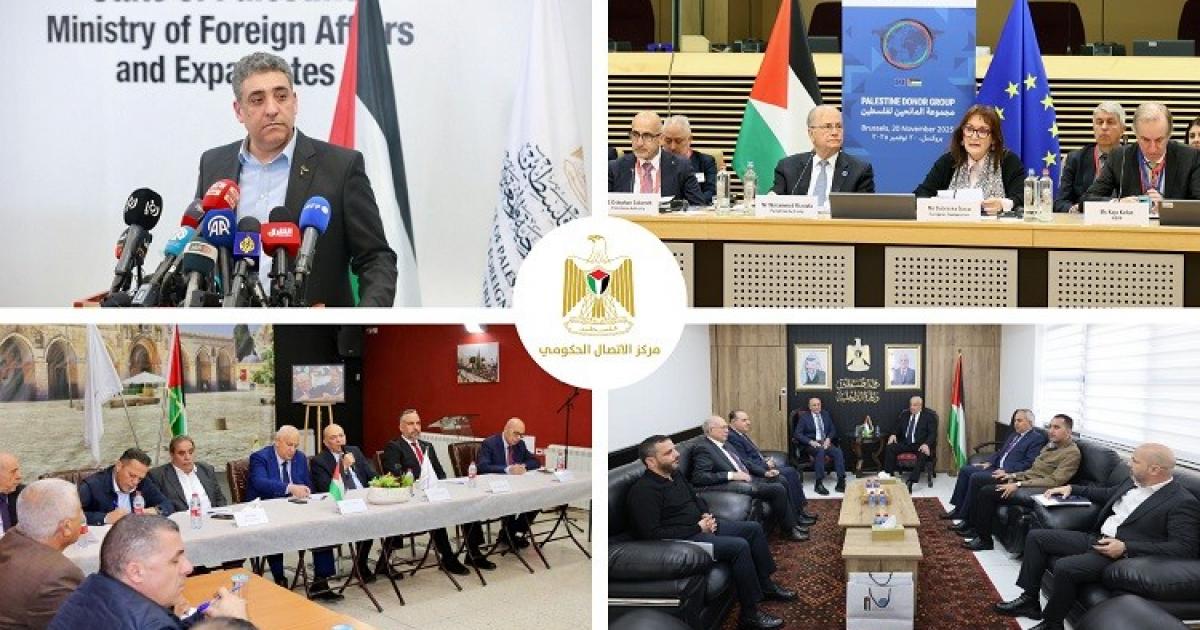
The Palestinian government continued its efforts to address critical needs and implement developmental and reformative projects across the territories during the week of November 16th-22nd, 2025. This report, released by the Government Communication Center on Sunday, November 23rd, 2025, details the significant interventions undertaken by various ministries, demonstrating a commitment to stability and progress despite ongoing challenges. The focus remains on providing humanitarian aid, strengthening essential services, bolstering economic resilience, and advocating for Palestinian rights on the international stage. Key areas of intervention include Gaza, the West Bank, including Jerusalem, and projects aimed at long-term sustainable development.
Prime Minister’s Engagement and International Advocacy
Prime Minister Mohammad Shtayyeh actively participated in the donor conference for Palestine in Brussels, leveraging the opportunity to engage with numerous foreign ministers and European officials. Discussions centered on securing a lasting ceasefire in the Gaza Strip and intensifying international efforts to deliver unhindered humanitarian aid and essential relief supplies to the region. The Prime Minister underscored the urgent need for increased pressure on Israel to end the aggression targeting both the Gaza Strip and the West Bank, encompassing Jerusalem, and to facilitate the release of Palestinian funds currently being withheld. This highlights the continued diplomatic push for a resolution to the ongoing conflict and a commitment to alleviating the suffering of the Palestinian people.
Social Development Initiatives: Supporting Families and Vulnerable Groups
The Ministry of Social Development executed 4,217 interventions throughout the week, benefiting 1,453 families at a total value of 297,000 shekels. These encompassed vital areas like protection, care, health insurance, professional supervision, food security, and in-kind assistance. Specifically, 616 new sponsorships were approved, 107 health insurance services were provided, and 331 follow up visits were completed. A crucial initiative involved the Norwegian Institution providing rent subsidies for 30 families for six months (250 Euros monthly), alongside direct aid of 200 Euros per family. Furthermore, restoration work is underway on the homes of 70 families, budgeted at $3,500 per home. These efforts demonstrate a focus on direct support to the most vulnerable segments of Palestinian society.
Humanitarian Aid and Psychological Support in Gaza
Efforts to alleviate the humanitarian crisis in Gaza remain a top priority. In collaboration with Aisha Association, services were delivered to 180 women, and 1,550 psychological support sessions were conducted. Intervention also extended to 7 cases of separated children, with ongoing monitoring of 21 cases through the “SOS” program. Material aid distribution included 385 food parcels and vegetables, the transfer of 4 orphans, the provision of 8 tents through UNICEF, 1,256 hot meals, 545 water bottles, and 2,000 hygiene kits, facilitated by the Qatar Charity committee. This multi-faceted approach emphasizes not only addressing basic needs but also providing critical psychosocial support to those impacted by the conflict.
Strengthening Agricultural Resilience
The Ministry of Agriculture launched the 2025 Pesticide Guide, a crucial resource for farmers. A memorandum of understanding was also signed with “We Effect” to deliver agricultural aid – 40 tonnes of animal feed – to 100 farmers in Masafer Yatta, through the combined efforts of Relief Agricultural, Save the Children, and the local village council. In Jenin, 21.25 tonnes of fertilizer and 1350 liters of pesticides and inputs were distributed to 71 farmers by Relief Agriculture and the Palestinian Center for Development. The Palestinian Center for Economic and Social Development also provided production inputs to 16 farmers in Nablus. Further bolstering agricultural capacity, the Ministry approved the first shipment of 22 tonnes of Palestinian avocados to Turkey and organized workshops and meetings on enhancing value chains, protecting natural reserves, and improving date export standards. These initiatives aim to increase local food production and support the livelihoods of Palestinian farmers.
Infrastructure Development and Local Governance
The Ministry of Local Government completed the rehabilitation of internal roads in Juriş, southeast of Nablus, at a cost of 960,000 shekels. Additionally, the “Gaza Recovery and Early Recovery Plan” was launched, focusing on restoring municipal services and rebuilding the solid waste management system. The ministry welcomed the President’s issuance of the new Local Councils Election Law, viewing it as a significant national and reform accomplishment. Minister-level visits were conducted to Jericho and the Jordan Valley to assess local needs, and the municipality of Jericho was congratulated on winning the award for the best urban sustainability policy project in Milan for its solar-powered wastewater treatment plant. These steps underscore the importance of strengthening local governance and improving infrastructure.
Education, Healthcare, and Essential Services
The Ministry of Education and Higher Education completed the construction of Ras al-Far’a Basic Co-educational School in Tubas ($750,000) and the rehabilitation of schools in North Hebron ($350,000 plus $300,000 through UNICEF). New tenders were announced for school maintenance and expansion, demonstrating a sustained investment in the educational infrastructure. The Ministry of Health continued ongoing efforts to improve healthcare access, including partnerships to enhance services in various governorates and update health insurance agreements.
The Ministry of Public Works & Transport focused on road rehabilitation projects in Tulkarm, Nablus and Bethlehem, alongside maintenance of drainage systems and roads near hospitals. Similarly, the Ministry of Transport and Communications is actively working to replace and renew driver’s licenses for citizens of the Gaza Strip through the various governorate directorates.
Strengthening Security and International Cooperation
The Ministry of Interior conducted meetings with local peace committees to reinforce community security. Simultaneously, the Palestinian government has taken resolute action against crime, arresting 1108 wanted individuals and executing 3499 judicial warrants. Additional cooperation with international partners was evident through the Ministry of Foreign Affairs and Expatriates, which launched a national campaign to counter escalated Israeli crimes.
The updates from the various ministries demonstrate a broad spectrum of government activity, focused on providing essential services, supporting vulnerable populations, promoting economic development, and advocating for Palestinian rights. These ongoing developmental projects are vital for building a more resilient and sustainable future for Palestinians. Continued government interventions and international support are critical to navigating the challenges and realizing long-term stability. For a more complete overview of the Palestinian government’s work, please refer to the official reports from the Government Communication Center.