


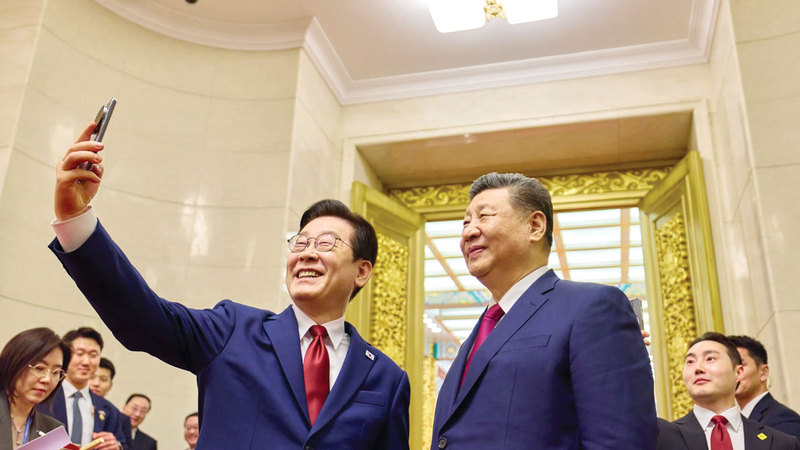
The year 2026 began with South Korean President Lee Jae-myung embarking on a remarkably complex diplomatic mission, one that could test even the most seasoned leaders. His initial steps – a state visit to Beijing, the first by a South Korean president in seven years, followed by a meeting with Japanese Prime Minister Sanai Takayachi in her hometown – signal a deliberate attempt to recalibrate South Korea’s position between two competing regional powers, navigating a delicately balanced landscape. This article will delve into the intricacies of this Korean diplomacy and its potential implications.
إعادة تشكيل العلاقات الإقليمية: مهمة الرئيس لي
Both China and Japan are actively courting South Korea, leaving President Lee to walk a tightrope. His strategy centers on deepening relations with both Beijing and Tokyo simultaneously, without being drawn into direct regional conflicts or aligning with one side at the expense of the other. A key, perhaps unspoken, aim is to contribute to de-escalating existing tensions between China and Japan. This approach is particularly crucial given the shifting global order and the uncertainties introduced by recent international political developments.
The increasingly interventionist policies of former US President Donald Trump, evident in situations from Venezuela to other global hotspots, have highlighted a growing instability. Across Northeast Asia, and mirroring concerns in Europe, there’s a palpable sense of a new world order emerging, one potentially fractured into competing spheres of influence.
Jang Ai-gil, an international affairs commentator for the Korean newspaper Hankook Ilbo, noted that “The United States under Trump no longer simply seeks global hegemony, but rather aims to consolidate its influence as the dominant power within the Americas, specifically.” This shift in US policy further complicates the regional dynamics and underscores the need for South Korea to proactively manage its relationships.
زيارة الصين: إحياء الروابط التاريخية والتركيز الاقتصادي
President Lee’s four-day visit to China in early January 2026 was a direct continuation of Beijing’s diplomatic outreach to the new South Korean administration. This outreach began with Chinese President Xi Jinping’s attendance at the Asia-Pacific Economic Cooperation (APEC) summit late last year. The Chinese messaging during the visit heavily emphasized friendship and mutual benefit, with a focus on expanding economic and cultural cooperation.
The scale of the accompanying delegation – approximately 200 senior business leaders – clearly demonstrated the priority given to economic interests. However, Xi and the Chinese leadership also subtly framed the relationship within a shared historical context, referencing the two countries’ past struggles against Japanese imperialism. This historical narrative is a powerful tool in Chinese diplomacy, designed to foster a sense of solidarity and common purpose. This is a key element of understanding South Korea’s foreign policy in the region.
التوترات الصينية اليابانية وتأثيرها على كوريا الجنوبية
Tensions between Beijing and Tokyo were already heightened following a public statement by Prime Minister Takayachi in November, hinting at potential Japanese involvement in a possible conflict over Taiwan. China responded by escalating its rhetoric and threatening restrictions on exports of “dual-use” technology. This backdrop adds another layer of complexity to President Lee’s diplomatic balancing act.
قضية تايوان والموقف الكوري الجنوبي
In this sensitive environment, President Lee signaled a willingness to address one of China’s core concerns: Taiwan. He reaffirmed South Korea’s longstanding position of respecting the “One China” principle. He also alluded to the shared history of resistance against “Japanese imperialism,” a deliberate echo of the Chinese narrative.
While the Republic of Korea was officially established in 1948, many Koreans actively participated in resisting Japanese occupation between 1910 and 1945. During his visit, Lee made a symbolic stop in Shanghai to commemorate the birthday of Kim Koo, a prominent leader of the Korean independence movement who headed a Korean government-in-exile there.
Despite these gestures, President Lee did not secure concrete commitments from China regarding pressuring North Korean leader Kim Jong-un to return to dialogue with Seoul. The Chinese response, while acknowledging the importance of dialogue, was largely generic and lacked any specific mention of the Korean peninsula situation. It fell short of even reiterating traditional support for denuclearization, a stance Seoul usually welcomes.
التقارب مع اليابان: فرص وتحديات
Following his China visit, President Lee traveled to Japan, where he met with Prime Minister Takayachi in her hometown of Nara. This meeting was viewed as a potential opportunity to break new ground in bilateral relations. Lee actively sought to dispel the perception of him as “anti-Japanese,” emphasizing the importance of building a future-oriented relationship, building on the progress made during the previous conservative administration led by Yoon Suk-yeol.
This potential for cooperation has sparked optimism among some observers, fueled by shared concerns about China’s rise and the need to coordinate responses to the unpredictable policies of the Trump administration. Japanese researcher Ayumi Terauchi wrote in Foreign Affairs that “The rapidly deteriorating security environment in the Indo-Pacific region makes cooperation between the two leaders (Lee and Takayachi) unavoidable.” This potential partnership is a significant development in regional security dynamics.
However, this optimism is predicated on several uncertain assumptions, including the ability to overcome deep-seated historical grievances related to war and colonialism, Takayachi’s willingness to move beyond her conservative nationalist stances, and the development of a common security vision.
قضايا عالقة وتحديات مستقبلية
The Nara visit proceeded relatively smoothly, with both sides avoiding contentious issues. However, underlying challenges remained. Takayachi continued to refer to the Dokdo islands (known as Takeshima in Japan) as “illegally occupied.” She also maintained her practice of visiting the controversial Yasukuni Shrine, dedicated to Japanese war dead, and did not rule out doing so again as Prime Minister.
President Lee is aiming for a pragmatic, cooperative relationship with Takayachi. Analysts predicted that this “shuttle diplomacy” could succeed as long as both leaders refrain from escalating sensitive issues – a condition that was met during their initial meeting.
However, simply avoiding difficult topics is unlikely to be sustainable in the long run. Genuine progress requires addressing these issues, particularly the matter of compensation for victims of forced labor and their families, which could lead to the seizure of Japanese corporate assets. Progressive voices in South Korea argue that focusing solely on strategic considerations fails to address the concerns of the public.
In an editorial, the Korean newspaper Kyungyang Shinmun argued that ignoring historical and regional issues is not a solution, pointing to Japan’s perceived indifference to these concerns, which it attributed in part to the weakness of the South Korean opposition.
الخلاصة: توازن دقيق ومستقبل غير مؤكد
There are currently no strong indications that Prime Minister Takayachi is seeking anything beyond maintaining a facade of cooperation. The biggest challenge for President Lee may be Takayachi’s consistently confrontational stance towards China, a stance that forms a cornerstone of her political base in Japan.
Despite these challenges, President Lee appears to be successfully managing the complex relationship between China and Japan, at least for the time being, with a degree of balance and flexibility. However, the ultimate outcome of this delicate equation remains uncertain. The success of this Korean diplomacy will depend on continued skillful navigation and a willingness from all parties to address underlying tensions constructively.