







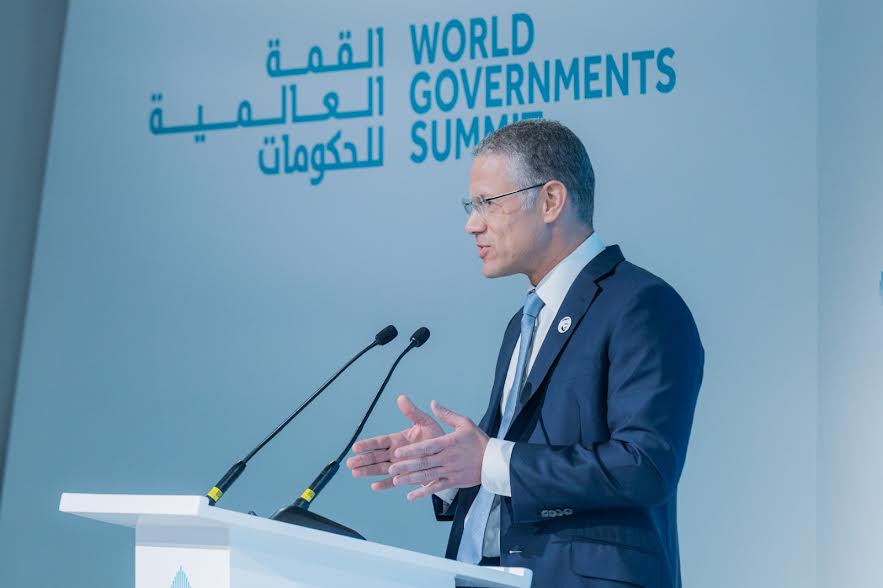
The global community is increasingly focused on harnessing the transformative power of artificial intelligence (AI), but ensuring its benefits are shared equitably remains a significant challenge. This was the central theme of a high-level dialogue, “Accelerating Impact with 5x AI,” held as part of the opening day of the World Governments Summit 2026. Leaders convened to discuss how to translate the principles of AI into measurable and scalable real-world impact, addressing a critical gap between investment and social good.
The Growing Disparity in AI Investment & Impact
Global investment in artificial intelligence has surpassed a staggering $1.5 trillion USD, yet less than one percent of this funding is directed towards social impact initiatives. A concerning 85% of this investment is concentrated in high-income countries, exacerbating existing inequalities. This imbalance was a key point of discussion during the closed-door dialogue, bringing together policymakers, international organizations, private sector representatives, and philanthropic leaders. The core issue isn’t a lack of innovation, but a lack of alignment between investment and equitable outcomes.
A New Operational Model for AI Development
Badr Jafar, the UAE’s Special Envoy for Business and Philanthropy, powerfully articulated the need for a fundamental shift in approach. He stated, “The challenge we face today is not a lack of innovation, but a lack of alignment. If AI is to become a tool for global convergence, not a cause for further inequality, we need a new operational model.”
Jafar introduced the “AI Impact Wheel” framework, outlining the crucial roles of different stakeholders. This framework highlights how public policies can set the direction and establish necessary regulations, strategic philanthropy can mitigate early-stage risks and facilitate experimentation, and the private sector can efficiently scale successful solutions. This collaborative approach is vital for maximizing the positive impact of AI technologies.
The UAE’s Pioneering Approach to AI Governance
The dialogue also spotlighted the United Arab Emirates’ proactive and comprehensive approach to AI governance. Since designating AI as a national priority in 2017, the UAE has integrated it into a broader institutional framework encompassing policy development, skills enhancement, and long-term capacity building. This model is now attracting attention and study from governments worldwide.
Jafar emphasized that the UAE’s success isn’t solely about the scale of investment, but how AI has been integrated into the institutional landscape. “What distinguishes the UAE is not just the size of the investment, but how AI has been embedded within an institutional framework. High levels of trust have accelerated the pace of implementation, and this relationship is critically important, because trust is not secondary in AI, it is the biggest obstacle to its adoption.” Building trust is paramount for widespread acceptance and effective implementation of AI solutions.
Focusing on Key Priority Areas
Participants identified five priority areas where collaborative, multi-sector efforts can accelerate AI adoption: healthcare, learning, community development, quality of life, and sustainability. While progress has been made in each of these areas, discussions underscored the importance of robust regulatory frameworks, a workforce prepared for the changing demands of the job market, and the establishment of common standards to ensure equitable scaling of impact. Machine learning and its applications within these sectors were also discussed as key drivers of progress.
The UAE: A Hub for Global AI Implementation
Concluding his remarks, Jafar reaffirmed the UAE’s role as a platform for bringing stakeholders together and driving implementation. “AI is advancing faster than institutions can adapt. Without conscious leadership, it will deepen inequality. But with coordinated action, it can expand inclusion at an unprecedented rate. The UAE is where the world gets things done.” The nation is positioning itself as a global leader in responsible AI development and deployment.
The World Governments Summit 2026 continues for three days in Dubai, bringing together heads of state, ministers, and global experts to discuss and shape the future of governance in areas including AI, climate action, economic resilience, and human development. The summit aims to foster collaboration and accelerate the responsible implementation of technologies like deep learning to address global challenges.
This summit represents a crucial step towards ensuring that the benefits of AI are accessible to all, fostering a more equitable and sustainable future. The discussions held underscore the importance of proactive governance, strategic investment, and collaborative partnerships in unlocking the full potential of this transformative technology.


