






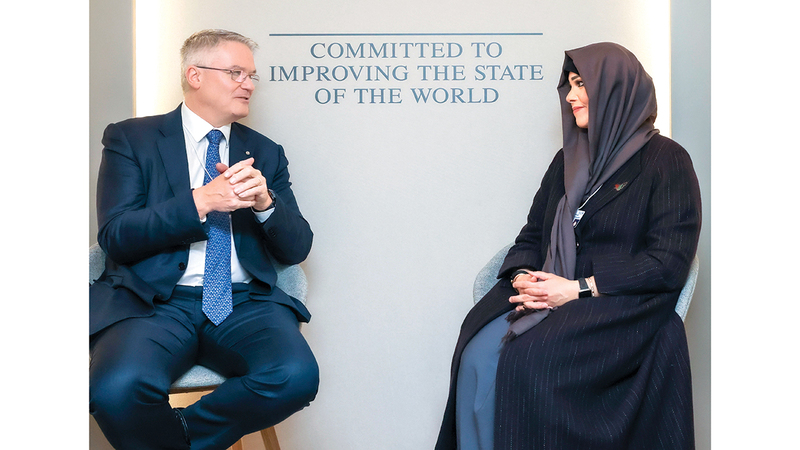
The global stage witnessed significant discussions on economic development and cultural advancement as Her Highness Sheikha Latifa bint Mohammed bin Rashid Al Maktoum, Chairperson of the Dubai Culture and Arts Authority (Dubai Culture), engaged in crucial meetings at the 56th World Economic Forum in Davos, Switzerland. These meetings underscored the UAE’s commitment to international collaboration and its proactive role in shaping a sustainable future. This article delves into the key takeaways from Sheikha Latifa’s discussions with the Secretary-General of the Organisation for Economic Co-operation and Development (OECD), Mathias Cormann, and the Director of the United Nations Development Programme (UNDP), Achim Steiner, highlighting the UAE’s vision for التنمية المستدامة (sustainable development).
تعزيز التعاون مع منظمة التعاون الاقتصادي والتنمية (Strengthening Cooperation with the OECD)
Her Highness Sheikha Latifa’s meeting with Mathias Cormann focused on the vital role the OECD plays in supporting public policies, fostering comprehensive and sustainable development, and refining economic and institutional frameworks. She emphasized the strong alignment between the OECD’s work and the UAE’s own developmental goals, particularly in areas like capacity building, improving the quality of government policies, and enhancing economic competitiveness.
The UAE recognizes the importance of learning from international best practices and actively seeks to expand its collaboration with the OECD. This includes leveraging the OECD’s expertise to further refine its own economic strategies and governance structures. The discussions highlighted a shared understanding of the need for adaptable economies capable of navigating global shifts.
دور السياسات الحكومية في تحقيق التنمية (The Role of Government Policies in Achieving Development)
Sheikha Latifa specifically noted the UAE’s dedication to developing innovative government work models and enhancing the efficiency of public policies. This commitment stems from a belief that a responsive and effective government is crucial for driving النمو الاقتصادي (economic growth) and improving the lives of citizens. The UAE’s approach is characterized by a willingness to experiment with new ideas and adapt quickly to changing circumstances.
Furthermore, the meeting touched upon the critical role of data and analysis in informed decision-making. The UAE is investing heavily in data infrastructure and analytical capabilities to ensure that its policies are evidence-based and targeted effectively.
الشراكة مع برنامج الأمم المتحدة الإنمائي (Partnership with the United Nations Development Programme)
In a separate meeting, Her Highness Sheikha Latifa reaffirmed the UAE’s unwavering commitment to supporting sustainable development efforts both regionally and globally. Her discussion with Achim Steiner, Director of the UNDP, centered on strengthening partnerships with international organizations, with the UNDP taking a prominent position. This collaboration is seen as essential for achieving shared development objectives and building more resilient and inclusive communities.
The UAE views the UNDP as a key partner in addressing complex global challenges, such as poverty, inequality, and climate change. By working together, the two entities aim to create a positive impact on the lives of people around the world. The meeting underscored the importance of a coordinated international response to these challenges.
الثقافة والمعرفة كركائز للتنمية (Culture and Knowledge as Pillars of Development)
The discussions extended beyond purely economic considerations to encompass the crucial role of culture and knowledge in fostering long-term development. Sheikha Latifa emphasized that investing in cultural initiatives and promoting knowledge sharing are vital for creating a vibrant and innovative society. This aligns with Dubai’s strategic focus on becoming a global hub for culture, creativity, and innovation.
The UAE recognizes that الاستثمار الثقافي (cultural investment) is not merely an aesthetic pursuit but a fundamental driver of economic and social progress. By nurturing its cultural landscape, the UAE aims to attract talent, stimulate creativity, and enhance its global reputation.
Both meetings, attended by Sheikh Mohammed bin Rashid bin Mohammed bin Rashid Al Maktoum, a member of the Board of Trustees of the Mohammed bin Rashid Al Maktoum Global Initiatives Foundation, and Minister of Cabinet Affairs, Mohammed bin Abdullah Al Gargawi, highlighted the UAE’s proactive stance on global issues. The presence of these key figures underscored the importance the UAE places on these international dialogues.
رؤية الإمارات للتنمية المستدامة (UAE’s Vision for Sustainable Development)
Her Highness Sheikha Latifa’s engagements in Davos clearly demonstrate the UAE’s commitment to a future built on sustainability, innovation, and international cooperation. The UAE isn’t simply reacting to global challenges; it’s actively shaping solutions and positioning itself as a leader in sustainable development.
The emphasis on government efficiency, data-driven decision-making, and cultural investment reflects a holistic approach to development that prioritizes both economic prosperity and social well-being. Furthermore, the UAE’s willingness to partner with organizations like the OECD and UNDP underscores its belief in the power of collective action.
In conclusion, Sheikha Latifa’s participation in the World Economic Forum served as a powerful platform to showcase the UAE’s vision for a more sustainable and equitable future. The discussions held in Davos will undoubtedly contribute to strengthening the UAE’s partnerships and accelerating its progress towards achieving its ambitious developmental goals. The UAE’s continued engagement on the global stage is crucial for fostering a collaborative environment and addressing the pressing challenges facing the world today. We encourage readers to explore the initiatives of Dubai Culture and the UNDP to learn more about these vital efforts.


