







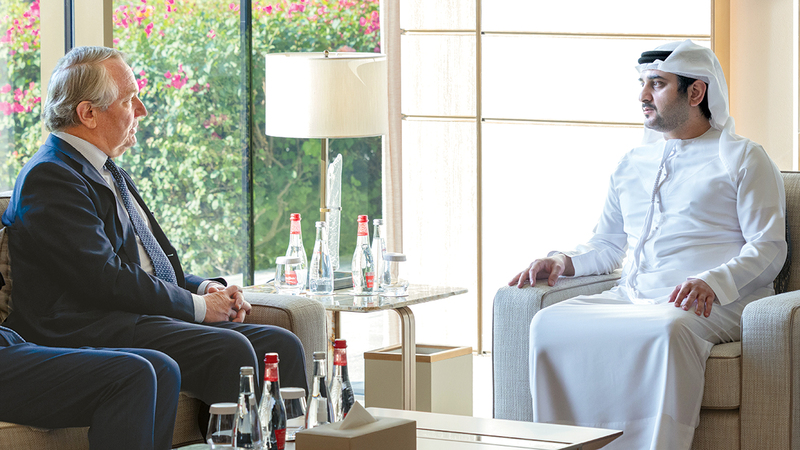
The United Arab Emirates continues to solidify its position as a global financial hub, attracting major international institutions and fostering an environment of innovation and growth. Recent discussions between Sheikh Maktoum bin Mohammed bin Rashid Al Maktoum, Deputy Ruler of Dubai, and Alexander Winandts, Chairman of the Supervisory Board of Deutsche Bank, highlight this trajectory. This meeting underscores the strengthening ties between the UAE and one of the world’s leading financial institutions and reaffirms Dubai’s commitment to becoming a premier destination for global capital. The focus of the discussion was the dynamic financial sector in the UAE and the opportunities it presents.
Meeting of Minds: Sheikh Maktoum and Deutsche Bank Leadership
The meeting, held at Sheikh Maktoum’s office, served as a platform to acknowledge the pre-existing successful collaborations between the UAE and Deutsche Bank. Both parties expressed a strong desire to further enhance these partnerships, capitalizing on the UAE’s rapidly evolving economic landscape. Winandts specifically discussed Deutsche Bank’s comprehensive services offered in the UAE and across the wider Middle East and Africa region, all operating from its strategic base within the Dubai International Financial Centre (DIFC).
These services encompass a wide range, including investment banking, asset management, private wealth management, and international transactional banking. It’s a clear signal of the bank’s long-term commitment to the region and belief in its future potential.
Growth Drivers: Innovation and Digital Transformation in UAE Finance
Sheikh Maktoum emphasized the substantial development and accelerated growth within the UAE’s financial and banking sector. He attributed this progress to the country’s proactive embrace of financial innovation and its dedication to speeding up digital transformation initiatives. This focus is actively creating a fertile ground for global banks like Deutsche Bank to thrive.
Advantage UAE: Governance, Regulation and Infrastructure
The UAE’s strong competitive advantages were also a central theme of the discussion. These advantages include sophisticated governance structures aligning with the highest international standards, a supportive regulatory and legislative framework designed to encourage business, and a world-class infrastructure. These elements combine to create a stable and attractive investment climate, a key factor in attracting significant foreign direct investment.
Sheikh Maktoum’s post on X (formerly Twitter) further articulated his vision, stating that Dubai will remain a magnet for capital, a breeding ground for innovative solutions, and a benchmark setter for the global financial industry. He also noted the growing confidence of global financial institutions in the UAE’s investment environment and its ability to fuel economic transformation.
Dubai’s Role and the D33 Agenda
A key focus of the conversation revolved around Dubai’s established role as a leading global financial and investment center. The Emirate is continuously seeking to attract capital and international financial institutions, steadily enhancing its ecosystem to support their growth and expansion. This commitment is directly aligned with, and actively contributing to, the objectives of the Dubai Economic Agenda “D33”.
D33 aims to double Dubai’s GDP and secure its position among the top three global cities for business and economic activity by the year 2033. Achieving these ambitious goals requires continued investment in innovation, infrastructure, and a welcoming business environment – all areas where Dubai consistently demonstrates leadership. The UAE’s financial prowess is central to this plan.
The meeting was attended by several high-ranking officials, including Mohammed bin Hadi Al Hussaini, Minister of State for Financial Affairs; Helal Saeed Almarri, Director General of Dubai’s Department of Economy and Tourism; Eissa Kazim, Governor of the DIFC; and Hisham Abdullah Al Qassim, Deputy Chairman and CEO of Emirates NBD. This strong representation highlights the importance of the meeting and the collaborative approach driving the UAE’s economic strategy.
Deutsche Bank’s Global Footprint and Performance
Deutsche Bank’s significance on the global stage was also acknowledged. Founded in 1870, the bank boasts a vast international network spanning 56 countries, employing approximately 90,000 individuals worldwide. As of the end of the third quarter of 2025, Deutsche Bank manages assets valued at around €1.054 trillion and oversees wealth amounting to approximately €675 billion.
Furthermore, the bank reported a 4% growth in its net revenues in 2024, reaching €30.1 billion. This positive performance validates its business strategy and demonstrates its resilience in a dynamic global market. This growth indicates a robust appetite for investment and expansion, solidifying its commitment to the financial investment landscape globally. Deutsche Bank is a significant player in the global financial technology sector and the UAE is a major player in that world.
In conclusion, the meeting between Sheikh Maktoum bin Mohammed and Alexander Winandts serves as a powerful indicator of the UAE’s, and specifically Dubai’s, flourishing financial sector. It underscores the country’s commitment to innovation, digital transformation, and attracting leading global institutions like Deutsche Bank. With a clear vision outlined in the D33 agenda and a robust framework for growth, the UAE is well-positioned to solidify its role as a global economic and financial powerhouse, and the ongoing partnership with Deutsche Bank will undoubtedly be a key component of that success. Readers interested in learning more about the D33 agenda are encouraged to explore resources provided by the Dubai Department of Economy and Tourism.


