






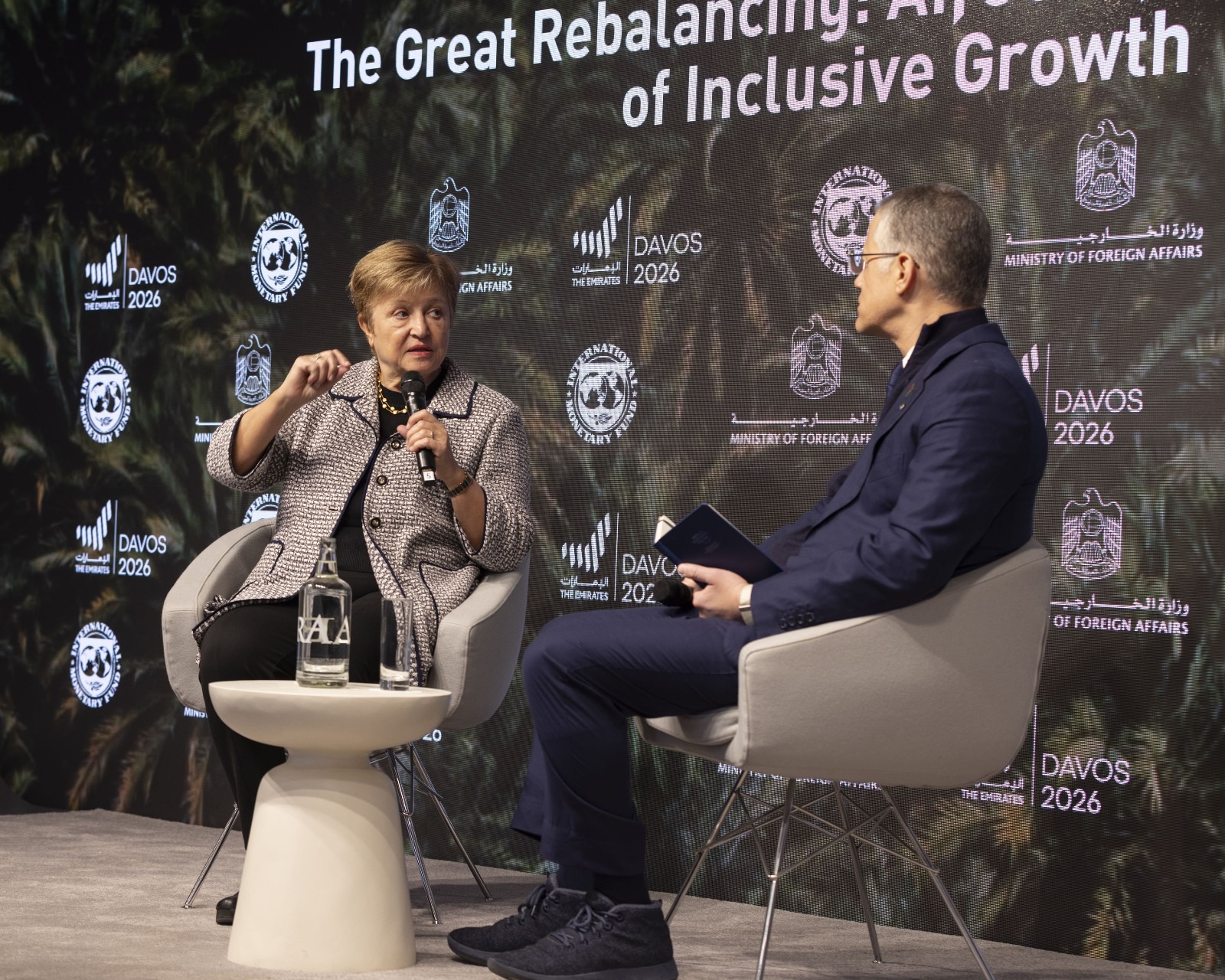
The United Arab Emirates recently hosted a high-level dialogue within its pavilion at the annual meeting of the World Economic Forum in Davos, bringing together global leaders to discuss the rapid transformations in the global economy, the impact of artificial intelligence on labor markets, and the future of inclusive growth. This pivotal discussion, titled “Reconciling Artificial Intelligence, Jobs, and the Future of Inclusive Growth,” underscored the urgency of adapting to a changing world and ensuring benefits are widely shared.
حوار دافوس: الإمارات تقود نقاشات مستقبل الاقتصاد العالمي والذكاء الاصطناعي (Davos Dialogue: The UAE Leads Discussions on the Future of the Global Economy and Artificial Intelligence)
The dialogue featured Bader Jafar, Special Envoy for Business and Philanthropic Affairs for the UAE, and Kristalina Georgieva, Managing Director of the International Monetary Fund (IMF). Their conversation centered on the opportunities and challenges presented by these sweeping changes and outlined economic expectations for the coming stages. The UAE’s proactive stance in hosting this discussion highlights its commitment to shaping the global economic narrative and fostering international collaboration.
دراسة صندوق النقد الدولي: تأثير الذكاء الاصطناعي على الوظائف (IMF Study: The Impact of Artificial Intelligence on Jobs)
A key focus of the discussion was a recent IMF study on global growth prospects and the risks of declining resilience, particularly concerning the transformations in the labor market driven by artificial intelligence. The study revealed a significant potential impact, estimating that around 40% of jobs globally will be substantially affected by AI – either benefiting from it, undergoing changes, or becoming entirely obsolete. This finding emphasizes the critical need for policies and investments that support communities during this transition. The study also points to the need for proactive measures to mitigate potential disruptions and ensure a just transition for workers.
مرونة الاقتصاد العالمي وتحديات التحولات الهيكلية (Global Economic Resilience and the Challenges of Structural Transformations)
Based on the IMF’s latest assessments, Kristalina Georgieva noted that the global economy has demonstrated remarkable resilience in maintaining steady growth despite ongoing global disruptions and volatility. The IMF has even revised its growth forecasts upwards. However, she cautioned against complacency, stressing that this resilience shouldn’t be taken for granted amidst deep structural shifts resulting from technological, geopolitical, and demographic changes, as well as climate change. These factors are creating a complex and uncertain environment for economic planning and require careful consideration.
Georgieva powerfully described the situation, stating, “A severe tsunami is hitting the labor market with the accelerating wave of artificial intelligence, which is changing the features of economies, creating jobs we have not known before and eliminating others completely.” To navigate these rapid transformations, she emphasized the importance of investing in skills development and preparing communities to adapt to the evolving landscape. However, her primary concern lies in the widening gap in growth and progress opportunities across different regions. This disparity requires targeted interventions and international cooperation to ensure equitable outcomes.
رؤية الإمارات: اقتصاد قائم على المرونة والترابط العالمي (UAE Vision: An Economy Based on Resilience and Global Interconnectedness)
Bader Jafar highlighted the UAE’s long-term strategic decision to build an economy based on resilience and global interconnectedness. “While global systems are experiencing fragmentation and division, the UAE is doubling its efforts to strengthen interconnectedness and cooperation,” he stated. “Our skies are open, our ports are accessible, and our minds are open. The data confirms the effectiveness of this advanced approach.” This commitment to openness and collaboration is a cornerstone of the UAE’s economic strategy.
He further elaborated that the UAE attracted over $45 billion in foreign direct investment (FDI) last year, representing a nearly 50% annual increase, while global FDI flows declined by 11%. The country accounted for more than half of all FDI flowing into the Middle East and ranked second globally in new investment projects, trailing only the United States. Additionally, the UAE welcomed approximately 10,000 new millionaires, the highest number worldwide. “In an era characterized by distance, we uniquely facilitate connection and interdependence, a strategic advantage we are committed to strengthening,” Jafar added. This demonstrates the UAE’s attractiveness as a global investment hub.
عوامل رئيسية لتحقيق النمو الشامل في عصر الذكاء الاصطناعي (Key Factors for Achieving Inclusive Growth in the Age of Artificial Intelligence)
To effectively manage this wave of change and achieve inclusive and equitable growth, Georgieva identified four key factors: the adaptability of the private sector, the responsible adoption of artificial intelligence, the sustainability of trade flows, and prudent fiscal policies. She also stressed the importance of public investments in education, digital infrastructure, and widespread access to AI tools, ensuring that communities can actively participate in the new AI-driven economy. Investing in human capital is crucial for harnessing the benefits of AI.
The discussion also acknowledged the IMF’s view of the UAE and the broader Gulf region as sources of strength and sustainable economic support. Georgieva explained that this performance is built on three fundamental pillars: continuous regulatory reforms, particularly reducing bureaucracy; sustainable economic diversification, with non-oil sectors now representing over 75% of the UAE’s GDP; and long-term investment in human capital, skills, and inclusion.
نحو نماذج نمو جديدة تركز على العدالة الاجتماعية (Towards New Growth Models Focused on Social Justice)
The session called for a re-evaluation of growth models to prioritize both economic efficiency and social justice. Both speakers emphasized the importance of empowering youth, providing jobs that ensure dignified lives, and enabling all segments of society to participate in economic development. The need for a human-centered approach to economic growth was a recurring theme.
The discussions underscored the role of governments, the private sector, and strategic philanthropy in leveraging the effectiveness of artificial intelligence to achieve sustainable and inclusive growth through social innovation, aligning incentives, and preparing for the widespread adoption and application of AI for social good.
This dialogue clearly demonstrated the UAE’s commitment to shaping global economic discussions, actively participating in international efforts to promote inclusive growth, developing artificial intelligence responsibly, and anticipating the future of work. The session, part of the UAE pavilion’s program at the World Economic Forum, reaffirmed the importance of responsible innovation, long-term capital, and cross-sectoral collaboration in building a more resilient and inclusive global economy.


